
Production data knows more than individual metrics show – does your company know how to ask the data the right questions?

This article was published as part of Kauppalehti’s online commercial partnership content on September 9, 2026.
Industrial systems accumulate vast amounts of measurement and process data. Advanced analytics reveals dependencies that would otherwise remain hidden.
Industrial companies often have years’ worth of accumulated data from sensors, machines, production lines, and process control systems. This data contains valuable information about the company’s and the production’s operations, yet it often goes unused. The challenge is that the information is scattered across different systems, examined as isolated metrics, or disconnected from production events, maintenance activities, and quality results.
With the help of AI and advanced analytics, phenomena that support decision-making and concrete actions can be identified from existing data. However, the first and most important step is not choosing the technology, but defining the business problem to be solved.
In the best use case, the problem has a significant financial impact, the data needed to examine it is available, and the analysis results can be used to improve operations. The question might be, for example, which signs predict the failure of a key machine, what explains quality deviations in production, or at which stage of the process unnecessary variation, energy consumption, or waste occurs.
What don’t individual metrics tell you?
Consider a situation where a machine’s key metrics appear normal, yet the machine still breaks down the next day. How is this possible?
Traditional threshold-based monitoring typically examines each metric separately. Temperature, vibration, or current consumption may not exceed their set alarm limits. Yet the machine’s mode of operation may have changed in a way that only becomes visible in the combined effect of several variables.
When the dependencies between the results indicated by different metrics are modeled together, it becomes possible to identify that the system as a whole is behaving differently than usual. This is called multivariate analysis. It can uncover signs that neither the human eye nor a single metric would detect. What matters, then, is not merely whether some metric crosses a predefined threshold. The more relevant question is: has the behavior of the machine or the entire process begun to change in a way that predicts a disturbance?
The same principle applies more broadly to identifying anomalies. Once an AI model learns what a normal production process looks like as the combined effect of dozens or even hundreds of variables, it can detect a change before it manifests as a quality defect, an unplanned shutdown, or a safety risk.
An anomaly detection alone, however, does not yet reveal the root cause of the problem. It can, though, direct experts’ attention to the right machine, process stage, and point in time before the problem has a chance to grow significant. This allows maintenance and production adjustments to be made proactively, rather than only after a fault has already occurred.
Perfect data isn’t required – a solid data foundation can be built
Even advanced analytics cannot produce reliable insights from poor-quality data. The value of the results depends on factors such as whether measurement timestamps are aligned, units of measurement are consistent, sensors are functioning properly, and missing values as well as different operating situations in production are properly identified.
However, the data doesn’t need to be perfect before starting the first project. A limited data audit quickly reveals what can be used from the current data as it is, which gaps affect the reliability of the results, and what information is worth starting to collect more systematically.
From business question to production use
Ai4Value helps industrial companies move from defining a business question to assessing data usability, piloting advanced analytics, and deploying it into production. The technical foundation for the solutions is Ai4Value’s own platform, ValueFactory.
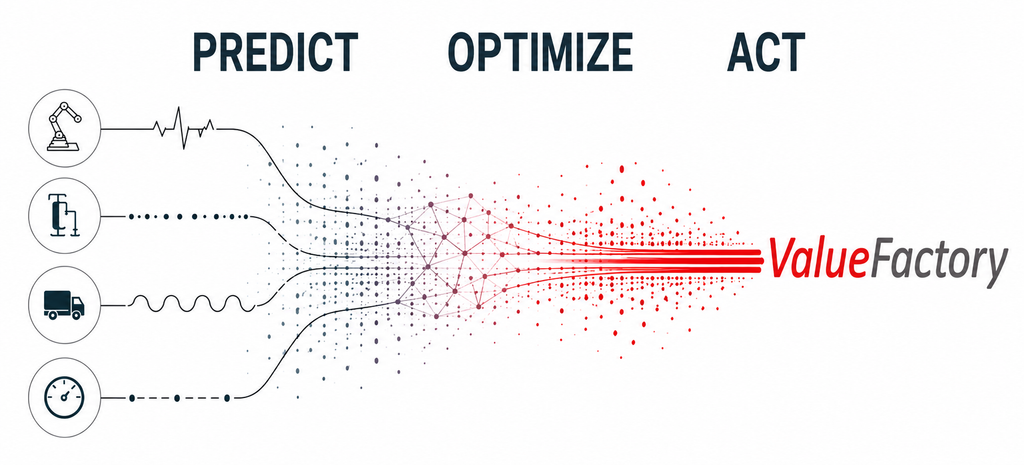
ValueFactory is Ai4Value’s own AI platform for industrial production environments, on top of which Ai4Value’s solutions run. ValueFactory combines real-time data processing, machine learning, semantic data modeling, and agent-based workflows. Its built-in Stream Analytics Engine (SAE) receives device and process data from various sources, processes it in real time, and harmonizes the data for use by analytics and AI models. OPC UA compatibility makes it easier to connect the platform to industry’s existing systems. The goal is that each new analytics solution doesn’t need to be built technically from scratch.
ValueFactory can be used to implement solutions for, among other things, anomaly detection, predictive maintenance, quality prediction, material identification, power grid balance prediction, and logistics optimization. By leveraging it, an industrial company doesn’t need to launch a large-scale AI program. What matters most is identifying the right, business-critical question and having sufficiently good-quality data. When these are combined with analytics suited for production use, years of accumulated industrial data can turn into fewer shutdowns, more consistent quality, lower costs, and better decisions.
Link to original Kauppalehti’s article Tuotannon data tietää enemmän kuin yksittäiset mittarit näyttävät – osaako yrityksesi kysyä datalta oikeat kysymykset?