
Context Awareness Is the Real Solution to Industrial AI
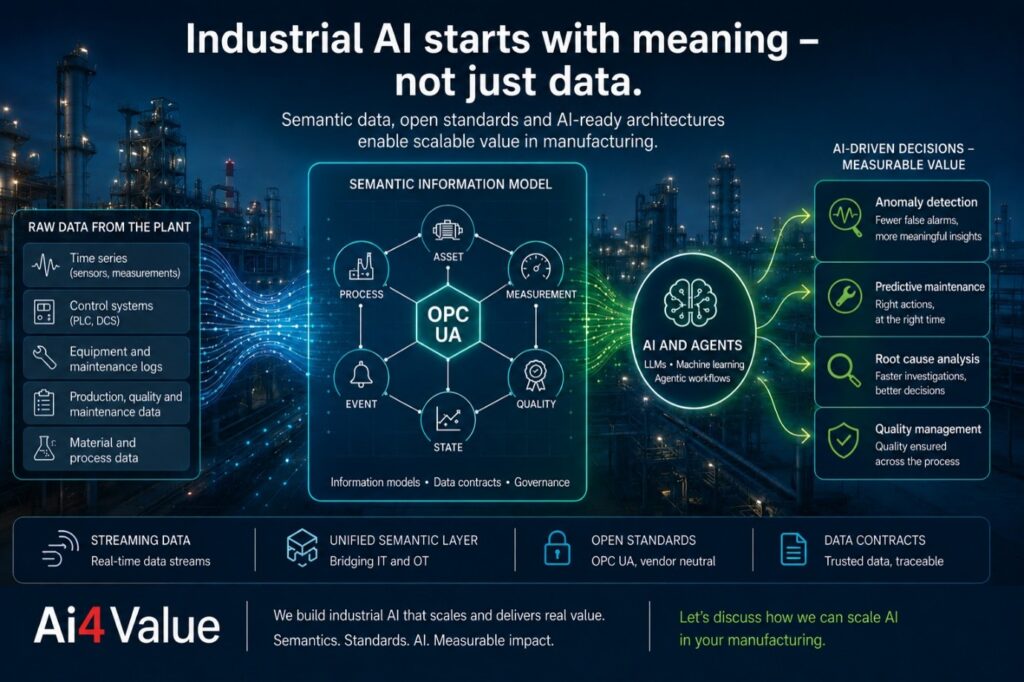
by Ai4Value CTO Pasi Karhu
Many industrial companies succeed with AI pilots but fail when trying to scale them. The reason is usually not a poor machine learning algorithm, but the fact that an algorithm alone does not understand the real operational environment around it. In addition to algorithms, AI systems need an understanding of the broader operational context in which the data is generated and interacts.
Factory production data typically consists of isolated tag lists and raw time-series data. This works well for automation systems, but it is not enough for modern AI systems that are expected to understand operations. If a model does not understand what it is looking at, it cannot draw meaningful conclusions from it. This is one of the key reasons why industrial AI pilots work in controlled environments but fail to scale beyond a single machine, production line, or facility.
Companies that succeed in anomaly detection, predictive maintenance, and AI-assisted quality management are not simply building better models. They are building a better industrial data foundation, where isolated signals are connected into unified operational events and relationships.
Context Is Built on Standards Through Semantic Information Models
For example, a vibration signal from a device alone tells AI very little. To make it useful, the system must understand which device the signal comes from, under what operating conditions it was measured, and how it relates to process stages, materials, or quality outcomes. Without this context, even a highly trained model operates at only half of its potential.
This is where semantic information models become essential. OPC UA information models, for example, make it possible to structure industrial data into meaningful entities instead of disconnected tags. When data has both structure and meaning, AI systems, including modern language models and AI agents, can reason about operations instead of merely detecting statistical deviations.
Why Anomaly Detection So Often Leads to Disappointment
Anomaly detection is one of the most common industrial AI applications. It is also one of the most common sources of disappointment, especially when implemented without operational context.
Context-unaware systems generate large numbers of false alarms alongside genuine anomaly detections: process transition states are interpreted as faults, product changeovers are flagged as anomalies, and normal operational variation triggers alerts. As a result, users lose trust in the system and begin ignoring its warnings, undermining the value of the entire investment.
When anomaly detection is built on semantically structured data, the situation changes fundamentally. By understanding equipment operating states and process relationships, the system can distinguish meaningful anomalies from normal variation. Alerts become operationally relevant instead of being merely statistical noise.
AI Agents Require Structured Data to Operate Reliably
AI agents are receiving significant attention in industrial environments, and for good reason. However, autonomous reasoning works reliably only when the underlying data is structured and properly governed. Without this foundation, agents operate inefficiently based on unsupported assumptions.
When the foundation is in place, agents can independently and consistently analyze operational data, support root cause analysis, and connect quality deviations to process conditions.
The potential is real, but it requires a functioning data architecture.
An Architecture Built for AI
The companies gaining the greatest value from industrial AI are those developing data architectures specifically designed to support AI. Industrial data generated as continuous streams from sensors and equipment, combined with a shared semantic layer between IT and OT and open standards such as OPC UA, enables AI to scale in anomaly detection, predictive maintenance, root cause analysis, and quality management.
At Ai4Value, we focus on industrial AI solutions that scale beyond pilots and integrate into real production environments. We achieve this through our Stream Analytics Engine platform and Factory Value concept. These combine traditional machine learning with semantic information modelling, OPC-based architecture, modern agentic workflows, and the intelligence of large language models.
Let’s discuss how the right data foundation can help AI scale successfully in your production environment as well.