
In Praise of Traditional AI
by Ai4Value CTO Pasi Karhu
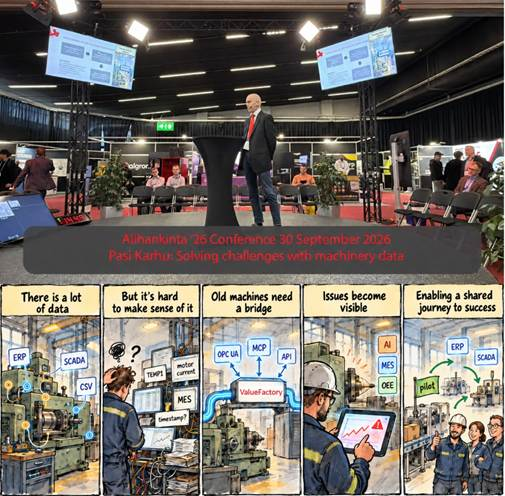
In recent years, the AI conversation has focused on language models and AI agents. They were one of the main themes at, for example, the Subcontracting Trade Fair (Alihankinta) in Tampere at the end of September. It feels as if AI had only just been invented…
Perhaps that is exactly why Ai4Value’s completely different perspective attracted particular attention at the Tampere fair.
TRADITIONAL AI HAS BEEN AROUND FOR DECADES AND IT IS STILL RELEVANT
In the generative AI discussion, which has at times bordered on hype, it is easy to forget that AI is by no means an invention of the last five years, and that earlier AI techniques have not all become obsolete. On the contrary, many machine learning (ML) methods developed over the decades are still highly relevant. Especially for analysing data streams from industrial equipment and for solutions that make operations more efficient, they are usually the best solution.
Language models are powerful for tasks such as processing text, retrieving information and enabling interaction between people and information systems. But if the task is to predict bearing failure from vibration data, detect an anomaly in a production process or assess product quality based on process variables, an AI agent is probably not the right solution.
In its industrial solutions, Ai4Value combines traditional machine learning with semantic information modelling, an OPC-based architecture and, only when needed, language models and agentic workflows. The choice is not about old versus new AI, but about applying the most suitable technology to each problem and its sub-challenges – combining old and new where necessary. The easiest approach is usually to start with sensor data from the equipment on the factory floor, and only after the first machine-learning-based analyses consider whether language models and agents would bring significant added value to the solution.
SIX TYPICAL MACHINE LEARNING METHODS
But what does this “traditional AI” mean in practice?
Below, I have collected six typical machine learning methods and their applications across different industries. Each of the core technologies mentioned can nevertheless be generalised to challenges in other industrial sectors. In addition, for each technology I have included a question relevant to decision-makers to prompt you to think about a possible solution to a specific challenge in your own production.
1. REGRESSION predicts a continuous quantity
Regression is one of the fundamental methods of machine learning. Its task is to predict a numerical value based on several other variables.
Example: forest industry. In a paper machine, the moisture of the end product is affected by a large number of process variables: temperatures, speeds, pressures and raw material properties. A regression model can be trained to estimate the moisture of the end product while the process is still running.
In practice, such a model acts as a virtual sensor, also known as a soft sensor. It can be used to estimate a quantity that may be difficult, slow or expensive to measure continuously with physical instruments.
The same idea works in many other fields too: estimating concentrations in the chemical industry, material properties in the metal industry or product quality in the food industry.
Question for decision-makers: is there an important quantity in your production that, if known earlier or in real time, would improve decision-making?
2. CLASSIFICATION identifies which group an observation belongs to
Whereas regression predicts a numerical value, a classification model assigns an observation to a class.
Example: food industry. Based on process and measurement data, products can be classified, for example, into approved products and those requiring inspection. The model learns from previous examples which combinations of measurements are associated with different quality classes.
The strength of classification performed with a machine learning algorithm is its ability to handle many variables simultaneously. What matters is not necessarily a deviation in a single measurement but a pattern formed by several factors together – something that typically becomes difficult for a human as the number of variables grows.
The same principle can be applied, for example, to quality control in the electronics industry, material identification or recognising the operating states of machines.
Question for decision-makers: does your production constantly involve decisions about which group a product, situation or event belongs to?
3. CLUSTERING finds groups we didn’t know existed
Not all machine learning requires a known correct answer in advance. In clustering, the algorithm searches the data for observations that are similar to one another and forms groups from them.
Example: chemical industry. A process can give rise to thousands of different operating situations. Clustering can be used to identify distinct production operating modes from historical data. One may correspond to efficient normal operation, another to a particular raw material combination, and a third to a situation that later turns out to be problematic for quality.
What is interesting is that these groups do not need to be defined in advance. The algorithm helps uncover structures in the data that might otherwise go unnoticed.
Clustering is therefore particularly well suited to situations where there is a lot of data but it is not yet clear exactly what to look for in it.
Question for decision-makers: do we really know the different operating modes of our production, or do we only look at them through individual metrics? Has our production data ever been examined as a whole, in a way that could reveal something surprising?
4. ANOMALY DETECTION notices that something has changed
In industry, one particularly useful application of machine learning is anomaly detection.
Its starting point is simple: the model is taught what normal operation looks like. The system then looks for situations in which the behaviour of a machine or process deviates from the learned normal.
Example: metal industry. The vibration, sound, power consumption and other measurements of a CNC machine together form the machine’s characteristic behaviour. A change in the relationships between them can indicate tool wear or a developing fault even before any single measurement exceeds its alarm limit.
This is an essential difference from traditional threshold monitoring. Individual temperature, vibration or current measurements may look normal even though their combined behaviour has already changed.
The same approach works, for example, for pumps, compressors, electric motors and entire production processes.
Question for decision-makers: do we want to know only when some individual threshold is exceeded, or already when the process as a whole starts behaving differently than usual?
5. TIME SERIES FORECASTING tells what is likely to happen next
Industrial data is often time series data. Consumption, production volume, pressure, temperature, flow or power demand change as a function of time.
The task of time series models is to use past behaviour to predict the future.
Example: energy production. Forecasting heat or electricity demand helps plan production and capacity use in advance. In addition to historical data, the model can be given other variables relevant to the forecast.
The basic idea is easy to generalise elsewhere as well: to forecasting production volumes, energy consumption, load, inventory needs or the development of a process variable.
A good forecast does not eliminate uncertainty, but it turns decision-making from reactive to proactive.
Question for decision-makers: which decision could be made better if we already knew, with reasonable reliability, what will happen in a few hours or days?
6. NEURAL NETWORKS find complex non-linear relationships
Neural networks, too, are a much older technology than the current wave of generative AI. Although large language models are also built on neural networks, a neural network is not the same thing as a language model.
In industrial analytics, a neural network can learn highly complex non-linear relationships between input data and the desired outcome.
Example: pharmaceutical manufacturing. In a manufacturing process, the properties of the end product can be affected by a large number of process parameters at the same time. A neural network can model the combined effect of these factors when a simpler linear model does not describe the phenomenon well enough.
The method is not limited to the pharmaceutical industry. The same idea can be applied to any process in which the relationships between variables are complex: materials manufacturing, energy production, chemical processes or machine condition modelling.
Question for decision-makers: is some important phenomenon in our production going unexplained because the relationships between variables are too complex to examine one at a time?
Don’t start with AI technology – start with the problem
These six methods share one common feature: they do not need a language model around them to create value.
This does not mean that language models and agents have no significant role in industry as well. An agent can, for example, bring the result of a traditional machine learning model to the user, combine it with other information or use an analytics model as one of its tools.
But an agent does not make a language model the best algorithm for every problem.
When a machine’s vibration changes, a process’s energy consumption is being forecast or product quality is being inferred from hundreds of measurements, the machine learning toolbox developed over decades is often exactly the right place to look for a solution. At Ai4Value, we are also able to develop new machine learning algorithms to replace established toolbox solutions when they are not sufficient.
Before choosing a method, however, it is worth asking an even more fundamental question:
Which business problem do we want to solve?
The first and most important step is not choosing the technology but defining the business problem to be solved. When the problem is valuable enough, the necessary data is available and the results of the analysis can genuinely influence operations, we have a good basis for selecting the best methods for choosing a practical AI tool.
Sometimes it is a language model.
Sometimes an AI agent.
And very often the answer may be good old machine learning.
Ai4Value offers industrial AI solutions utilising machine learning
Ai4Value’s ValueFactory platform combines factory-floor data with machine-learning-based analytics and forecasting. It enables rapid development, deployment and scaling of AI solutions. When needed, agentic systems can also use the results via an MCP interface.
#ValueFactory