
Turning Legacy Manufacturing Data into AI-Ready Intelligence
By Ai4Value CTO Pasi Karhu, 2.9.2026
Why is data from an older factory challenging for AI?
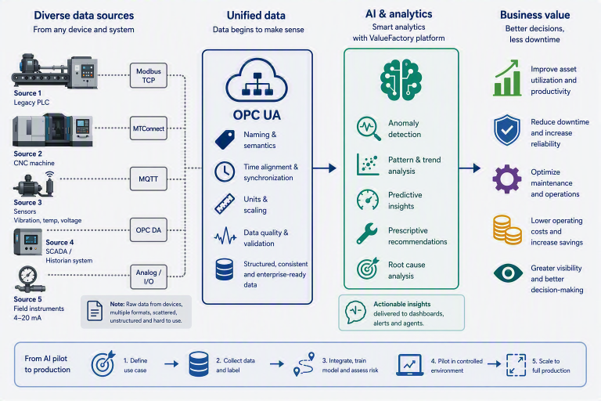
The challenge is rarely a lack of data. Most industrial organisations already collect vast amounts of operational information, but disconnected systems and inconsistent data models make it difficult to turn that information into measurable business value. The technical environment of a factory that has been operating for years or decades is rarely uniform. Production lines typically contain machines, controllers, and systems of different ages from multiple manufacturers. Raw data from equipment and sensors travels through many different interfaces and ends up scattered across various systems. The overall environment has often evolved incrementally, without a common plan or a unified view that AI could use to generate cost savings.
What does AI require from production data?
AI analytics requires more than access to measurement values. Data names, timestamps, units, and meanings must be understandable and consistent. Differences in sampling frequencies and data latency must also be reconciled with the intended use case. Historical data may be sufficient to identify a slowly developing process deviation, whereas detecting a rapidly emerging mechanical fault may require higher-frequency measurements closer to the machine.
How can integration challenges in a brownfield environment be addressed?
The challenges of a brownfield environment are not purely technical. Documentation may be outdated, system ownership may be unclear, and critical knowledge may reside with individual employees. The boundary between the operational technology (OT) network and the IT environment must be crossed in a controlled manner without compromising production availability or cybersecurity. Changes to a functioning production system are also undesirable unless there is a clear benefit and the risks are carefully managed.
What role does OPC UA play in harmonizing production data?
The partnership between Ai4Value and Prosys OPC, announced last week, provides a controlled approach to addressing these challenges. While the OPC UA standard itself is open, Prosys OPC UA Forge helps collect production data from different sources and harmonizes and structures it into an understandable format close to where the data originates. This allows even legacy equipment and systems to be connected through a modern, interoperable interface without making unnecessary changes to functioning control systems.
How does Ai4Value use harmonized data for AI?
Once the foundational data is in order, Ai4Value enriches the harmonized data with additional context from the production environment and develops intelligent machine-learning algorithms. When appropriate, we also utilise modern large language models. The analytics solutions provided by the ValueFactory platform enable applications such as anomaly detection, multivariate dependency modeling, intelligent soft sensors, predictive maintenance, and root cause analysis. The objective is therefore not merely to transfer data from one system to another, but to transform it into actionable information that supports production.
How should an industrial AI pilot be launched?
If it is not practical to tackle all the data on the factory floor at once, the work can begin with a clearly defined use case: What needs to be detected or predicted? How quickly are results required? Where can the necessary data be obtained?
Once the data sources, data quality, and integration path have been assessed, the solution can be piloted on a single critical asset, and later expanded to the rest of the production environment. In this way, a legacy factory environment can gradually be transformed into a reliable foundation for the use of AI.